Average Penis Girth: Chart & How to Measure
Medically reviewed by Grant Disick, MD, board-certified urologist · Written by Sean Rice, MD · Reviewed
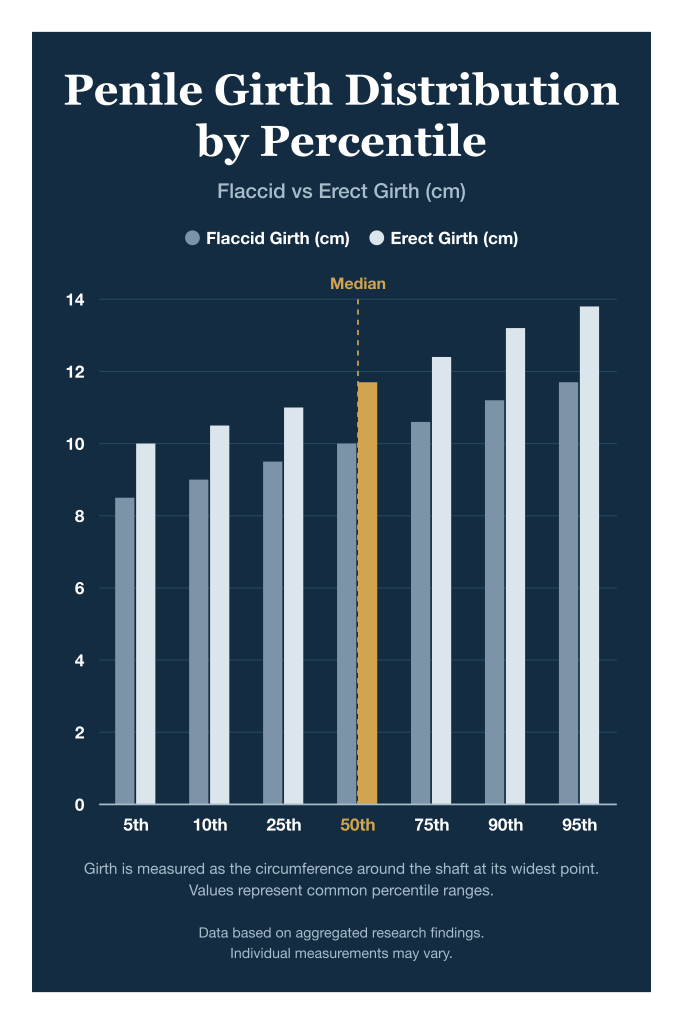
The average erect penis girth is 4.6 inches (11.7 cm), measured around the middle of the shaft, and the average flaccid girth is 3.9 inches (10.0 cm). About two in three men measure between 4.1 and 5.1 inches erect, according to a review of up to 15,521 men measured by health professionals.[1] For length, see the penis length percentile chart.
If you’re looking for accurate, medically-sourced data on average penile girth measurements, this comprehensive guide provides the most current research-based information available. Understanding where you fall on the size spectrum can provide perspective and peace of mind, whether you’re simply curious or considering your options.
The data presented here is based on the largest and most comprehensive meta-analysis ever conducted on penile measurements, published in the British Journal of Urology International (BJU International), which analyzed data from 15,521 men across multiple studies worldwide.
Comprehensive Girth Size Chart
Penile girth is measured as the circumference around the shaft at its widest point (typically mid-shaft). The table below shows both flaccid and erect girth measurements across different percentiles.
| Percentile | Flaccid Girth (Circumference) | Erect Girth (Circumference) | What This Means |
|---|---|---|---|
| 5th | 3.3 inches (8.5 cm) | 3.9 inches (10.0 cm) | 5% of men are at or below this size |
| 10th | 3.5 inches (9.0 cm) | 4.1 inches (10.5 cm) | 10% of men are at or below this size |
| 25th | 3.7 inches (9.5 cm) | 4.3 inches (11.0 cm) | 25% of men are at or below this size |
| 50th (Average) | 3.9 inches (10.0 cm) | 4.6 inches (11.7 cm) | Average penis girth |
| 75th | 4.2 inches (10.6 cm) | 4.9 inches (12.4 cm) | 25% of men are at or above this size |
| 90th | 4.4 inches (11.2 cm) | 5.2 inches (13.2 cm) | 10% of men are at or above this size |
| 95th | 4.6 inches (11.7 cm) | 5.4 inches (13.8 cm) | 5% of men are at or above this size |
Source: Veale, D., Miles, S., Bramley, S., Muir, G., & Hodsoll, J. (2015). Am I normal? A systematic review and construction of nomograms for flaccid and erect penis length and circumference. BJU International, 115(6), 978-986.
Erect Girth Distribution
This visual representation shows how the population is distributed across different girth measurements:
10%
Below Average
Above Average
10%
3.9″ ←────── 4.6″ (Average) ──────→ 5.4″
Average Erect Girth (Circumference)
How to Measure Girth Correctly
Accurate measurement is essential for understanding where you truly fall on the size spectrum. Many men measure incorrectly, leading to inaccurate conclusions. Follow these steps for a proper measurement:
Proper Measurement Technique
- Achieve full erection: Girth measurement should only be taken when fully erect, as partial erections will give inaccurate readings.
- Use a flexible measuring tape: A cloth or flexible plastic measuring tape works best. A string with a ruler is an alternative.
- Measure girth at mid-shaft: Wrap the measuring tape around the shaft at its widest point, typically halfway between the base and the glans (head). This is the standard measurement location.
- Keep the tape level: The tape should be perpendicular to the shaft, not angled. It should be snug but not compressed into the skin.
- Record the circumference: Note where the measuring tape meets itself. This number is your girth measurement.
- Convert girth size to girth diameter if needed: To calculate diameter, divide circumference by π (3.14). For example, a 4.6″ circumference = approximately 1.46″ diameter.
Common Measurement Mistakes
❌ Measuring at the Base
The base is typically thicker than mid-shaft. Standard measurements are taken at mid-shaft for consistency.
❌ Measuring While Partially Erect
Partial erections give significantly smaller measurements. Wait for full erection for accuracy.
❌ Pressing Too Hard
Compressing the tape into skin creates artificially larger measurements. Keep it snug but not tight.
❌ Angled Measurement
If the tape wraps at an angle rather than perpendicular to the shaft, it will measure longer than actual girth.
Understanding the Data
What “Average” Really Means
The average erect girth of 4.6 inches represents the 50th percentile—the exact middle of the distribution. However, “normal” encompasses a much wider range. In statistical terms, any measurement within two standard deviations of the mean (approximately 3.6 to 5.6 inches for erect girth) falls within the typical range experienced by 95% of men.
This means that there is substantial natural variation, and the difference between the 25th and 75th percentiles is only about 0.6 inches. Small differences in measurement can represent significant shifts in percentile ranking.
The Normal Distribution Curve
Penile girth follows a normal distribution (bell curve) pattern across the population. This means:
- 68% of men fall within one standard deviation of the average (approximately 4.1-5.1 inches)
- 95% of men fall within two standard deviations (approximately 3.6-5.6 inches)
- Measurements at the extreme ends are increasingly rare
Girth vs. Length: What Matters?
While length tends to receive more attention in popular culture, research suggests that girth may be equally or more important for sexual satisfaction. A study published in the Journal of Sexual Medicine found that girth was rated as more important than length by survey respondents when considering factors contributing to sexual pleasure.
The reason is anatomical: the first 3-4 inches of the vaginal canal contain the most nerve endings, and stimulation of these areas is influenced more by circumferential contact (girth) than by depth (length).
Source: Eisenman, R. (2001). Penis size: Survey of female perceptions of sexual satisfaction. BMC Women’s Health, 1(1), 1.
Debunking Common Myths
Myth: You can predict penis size from other body parts
Reality: Multiple studies have found no correlation between penis size and height, hand size, foot size, or any other body measurement. A 2002 study in the British Journal of Urology International examining 104 men found no predictive relationship between stretched penile length and height, weight, or body mass index.
Myth: Significant differences exist between ethnic groups
Reality: While small average differences have been noted in some studies, the variation within any given population group is far greater than the variation between groups. The BJU International meta-analysis found that individual variation dwarfs any population-level trends.
Myth: Pornography represents typical sizes
Reality: Adult film performers are specifically selected for above-average measurements, often in the 90th percentile or higher. Additionally, camera angles, smaller performers, and other filming techniques create visual distortions. Research shows that exposure to pornography correlates with decreased body satisfaction and skewed perceptions of typical anatomy.
Age and Girth
Limited research exists on age-related changes to penile girth specifically. However, studies have noted that some men may experience slight decreases in both length and girth with advanced age, potentially related to decreased testosterone levels, vascular changes, and loss of elastic tissue. These changes, when they occur, are typically modest and gradual.
Peak measurements are generally achieved in late adolescence to early adulthood, with relative stability through middle age for most men.
Scientific Research and Methodology
The data presented in this article primarily draws from the 2015 BJU International systematic review and meta-analysis by Veale et al., which represents the gold standard in penile measurement research. This study:
- Analyzed 17 studies conducted across multiple countries
- Included measurements from 15,521 men aged 17 and older
- Excluded self-reported measurements to ensure accuracy
- Used standardized measurement protocols
- Included only studies where measurements were taken by healthcare professionals
The research team created nomograms (graphical representations of statistical distributions) that allow men to see where they fall relative to the general population. These nomograms have been validated and are now used by medical professionals worldwide.
Additional Supporting Research
- Herbenick et al. (2014): Survey of 1,661 sexually active men in the United States, which found a mean erect circumference of 4.8 inches, closely aligning with international data.
- Wessells et al. (1996): Study of 80 men that established many of the standardized measurement protocols still used today.
- Schneider et al. (2001): German study of 111 men contributing to understanding of the correlation (or lack thereof) between flaccid and erect measurements.
Conclusion
Understanding penile girth measurements in the context of scientifically validated data can provide valuable perspective. The research clearly shows that “normal” encompasses a broad range of measurements, with the vast majority of men falling between 4.1 and 5.1 inches in erect girth.
If you’re within this range—or even somewhat outside of it—you’re experiencing measurements that are common and typical among adult men. The scientific literature emphasizes that anatomical variation is natural, normal, and expected across all human physical characteristics.
For those interested in exploring their options regarding size, consulting with a qualified medical professional who specializes in men’s health and urological procedures can provide personalized guidance based on your individual anatomy and goals.
Frequently Asked Questions
What is the average penis girth?
The average erect girth is 4.6 inches (11.7 cm) around the middle of the shaft. The average flaccid girth is 3.9 inches (10.0 cm). Both are the 50th-percentile figures in the table above.
What is a normal penis girth?
About 68% of men measure between 4.1 and 5.1 inches erect, and about 95% measure between 3.6 and 5.6 inches.
Is a 5-inch girth above average?
Yes. An erect girth of 5 inches falls between the 75th percentile (4.9 inches) and the 90th percentile (5.2 inches).
How do I measure penis girth?
When fully erect, wrap a flexible tape measure once around the middle of the shaft. Keep it level and snug without pressing into the skin, and read the number where the tape meets itself. Measuring at the base, while partly erect, or with the tape at an angle gives a wrong reading.
How do I convert girth to diameter?
Divide the circumference by π (about 3.14). An erect girth of 4.6 inches is a diameter of about 1.46 inches.
Does girth matter more than length?
In the survey of women cited below (Eisenman, 2001)[6], girth was rated as more important than length for sexual satisfaction.
References
Veale, D., Miles, S., Bramley, S., Muir, G., & Hodsoll, J. (2015). Am I normal? A systematic review and construction of nomograms for flaccid and erect penis length and circumference. BJU International, 115(6), 978-986.
DOI: 10.1111/bju.13010
Herbenick, D., Reece, M., Schick, V., & Sanders, S. A. (2014). Erect penile length and circumference dimensions of 1,661 sexually active men in the United States. Journal of Sexual Medicine, 11(1), 93-101.
DOI: 10.1111/jsm.12244
Wessells, H., Lue, T. F., & McAninch, J. W. (1996). Penile length in the flaccid and erect states: Guidelines for penile augmentation. Journal of Urology, 156(3), 995-997.
DOI: 10.1016/S0022-5347(01)65682-9
Schneider, T., Sperling, H., Lummen, G., Syllwasschy, J., & Rübben, H. (2001). Does penile size in younger men cause problems in condom use? A prospective measurement of penile dimensions in 111 young and 32 older men. Urology, 57(2), 314-318.
DOI: 10.1016/S0090-4295(00)00925-0
Shah, J., & Christopher, N. (2002). Can shoe size predict penile length? BJU International, 90(6), 586-587.
DOI: 10.1046/j.1464-410X.2002.02974.x
Eisenman, R. (2001). Penis size: Survey of female perceptions of sexual satisfaction. BMC Women’s Health, 1(1), 1.
DOI: 10.1186/1472-6874-1-1
Lever, J., Frederick, D. A., & Peplau, L. A. (2006). Does size matter? Men’s and women’s views on penis size across the lifespan. Psychology of Men & Masculinity, 7(3), 129-143.
DOI: 10.1037/1524-9220.7.3.129
Wylie, K. R., & Eardley, I. (2007). Penile size and the ‘small penis syndrome’. BJU International, 99(6), 1449-1455.
DOI: 10.1111/j.1464-410X.2007.06806.x
Ponchietti, R., Mondaini, N., Bonafè, M., Di Loro, F., Biscioni, S., & Masieri, L. (2001). Penile length and circumference: A study on 3,300 young Italian males. European Urology, 39(2), 183-186.
DOI: 10.1159/000052434
Grov, C., Parsons, J. T., & Bimbi, D. S. (2010). The association between penis size and sexual health among men who have sex with men. Archives of Sexual Behavior, 39(3), 788-797.
DOI: 10.1007/s10508-008-9439-5